

The lowest quoted fare can be the least useful measure of a corporate chauffeur booking. A corporate travel manager’s guide to booking Tri-State chauffeurs starts with the full journey: pickup and drop-off locations, service type, timing, stops, and booking terms all shape the quote. The price depends on the individual trip and is provided after a quote request.
For a single airport-to-office journey, a direct transfer may be the right fit. A day of client meetings or a roadshow may call for hourly service. Either way, establish the full itinerary, from the pickup point to the final drop-off.
This guide explains how routes, pickup requirements, busy travel dates, waiting time, and recurring plans affect corporate chauffeur bookings across New York, Westchester, and Connecticut. Learn what details to organize, how to choose a service format, and which booking terms to review so your travel plan supports both the schedule and the budget.
Key Takeaways
- Match the booking format to the itinerary: a direct transfer can suit one airport-to-office trip, while hourly service may work better for multiple meetings or a roadshow.
- Provide the flight number, arrival date, destination, meeting point, and traveler contact plan to coordinate an airport pickup smoothly.
- Choose vehicle capacity around passenger and luggage needs, and account for arrival timing and accessibility requirements when planning the trip.
- Plan ahead for busy periods: the guide recommends reserving domestic corporate trips at least 14 days in advance and international trips at least 21 days in advance.
- For recurring travel, standardize traveler details, approval contacts, itineraries, and billing instructions, then review quote terms such as tolls, parking, waiting, and cancellation policies.
How Corporate Travel Pricing Works?
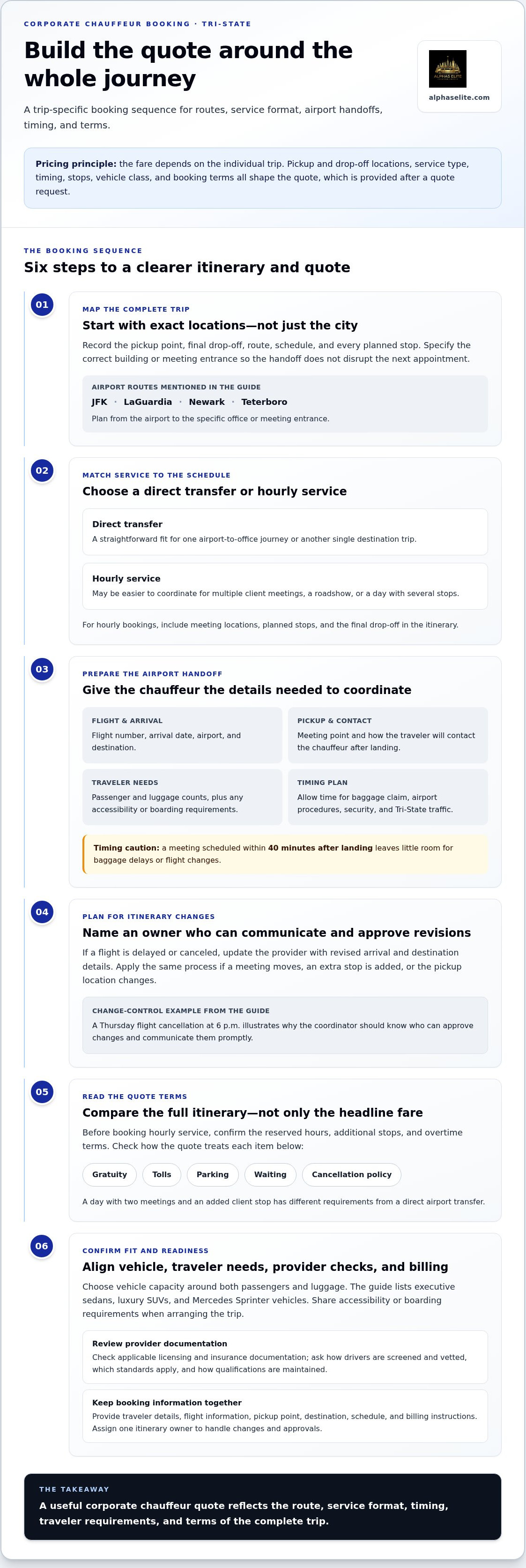
A corporate travel manager guide to booking Tri-State chauffeurs should begin with the journey’s full scope, not just the vehicle. Pickup and drop-off locations establish the route and geographic reach. Service format, stops, timing, vehicle class, and booking terms add detail. The price depends on the trip and is provided after a quote request; these itinerary factors shape it.
For airport-to-meeting transportation, weigh a pre-arranged car service against rail, rental cars, taxis, and ride services. The best fit depends on the traveler’s itinerary, luggage, and arrival point. A direct transfer may suit one airport-to-office trip. Multiple client meetings or a roadshow may be easier to coordinate with hourly service, especially when the schedule includes several stops.
Airport choice also shapes the ground plan. A traveler landing at JFK, LaGuardia, Newark, or Teterboro needs a route to the right office or meeting entrance. Plan for the exact destination, not just the city. A pickup at the wrong building entrance can disrupt the handoff and the next appointment.
For an airport pickup, provide the flight number, arrival date, and destination. Set out the meeting point and how the traveler will contact the chauffeur after landing. Include luggage and baggage claim in the timing plan, and allow sufficient time for airport procedures, security, and Tri-State traffic. A meeting scheduled within 40 minutes after landing leaves little room for baggage delays or flight changes.
Costs and timing can shift when the itinerary changes. If a flight is delayed or canceled, update the transportation provider with revised arrival and destination details. A Thursday flight cancellation at 6 p.m. illustrates why coordinators should identify who can approve changes and communicate them promptly. Apply the same discipline when a meeting moves, an extra stop is added, or the pickup location changes.
Before booking hourly service, review the reserved hours, additional stops, and overtime terms. Check how the quote handles gratuity, tolls, parking, waiting, and cancellation. Comparing these details helps assess the whole itinerary, not just a headline figure. A day with two meetings and an added client stop has different requirements from a direct airport transfer.
Companies should review applicable licensing and insurance documentation, then ask how drivers are screened and vetted. Clarify which standards apply to the route and vehicle, and how qualifications are maintained.
To book and manage reservations, provide traveler details, flight information, pickup point, destination, schedule, and billing instructions together. Assign one itinerary owner to communicate flight or meeting changes and approve revisions. Use this corporate travel manager guide to booking Tri-State chauffeurs as a checklist for capturing those details consistently.
Ground transport selection by arrival time, group size, luggage, and accessibility needs
For travel between Pearl River and other destinations in Rockland County, start with the traveler’s arrival time and destination. Compare options against passenger count, luggage, accessibility needs, and the schedule that follows.
Matching Transport to Passenger Needs
Choose vehicle size based on both the number of colleagues and their luggage. A small executive party may suit a premium sedan, while colleagues with conference materials may need a larger vehicle. Alphas Elite offers executive sedans, luxury SUVs, and Mercedes Sprinter vehicles. Describe any accessibility or boarding requirements when arranging transport so the booking reflects the traveler’s needs.
Arrival time influences the best fit. A traveler arriving late with luggage for one office visit has different needs from a client arriving before a full day of meetings. Hourly transportation can keep several appointments together; a single airport-to-office trip is more direct. For a conference or event, coordinate passenger arrival times and destinations before choosing transport, so the plan works for the group, not just one traveler.
Preparing Transfer and Chauffeur Booking Details
For an airport transfer or hourly chauffeur, gather the flight number, arrival date, pickup point, destination, and traveler contact details. Add passenger and luggage counts, accessibility requirements, and the requested service type. For an hourly itinerary, include meeting locations, planned stops, and the final drop-off. This creates a practical booking brief for an airport arrival, client visit, or multi-stop day.
Group travel takes coordination beyond the lead passenger. For colleagues arriving on separate flights, record each arrival and decide whether one itinerary or separate pickups best suits the schedule. A conference group may need transport between an airport, hotel, and venue; a private client visit may call for an individual pickup. Clear pickup locations and a named group contact reduce confusion at busy terminals and event entrances.
In Pearl River and Rockland County, consider where the traveler is going next. Compare rail, rental cars, taxis, ride services, and pre-arranged transportation for the route and timing. A rental car may suit a traveler making independent stops; a pre-arranged transfer can connect an airport arrival with a scheduled meeting. For repeated meetings, hourly service may better match a changing itinerary. Corporate transportation for business itineraries can be considered when coordinating these journeys.
Before confirming the plan, put the booking details in one itinerary. Include arrival time, pickup address, destination entrance, passenger and luggage counts, and the meeting schedule. For conference transport, add venue names and the group contact. This gives coordinators a concise reference if arrivals shift or a traveler needs a different handoff point.
Advance reservations for busy dates and peak travel periods
Advance reservations help corporate travel teams plan for busy dates and peak periods. Conferences, company events, and tightly scheduled client visits can create simultaneous pickup needs. Reserve around the destination, arrival time, and onward schedule instead of relying on an on-demand ride after landing. Planning ahead also gives coordinators time to align traveler details and approvals.
For domestic corporate trips, the guide recommends booking transportation at least 14 days in advance. For international corporate trips, it recommends booking at least 21 days in advance. Treat these as planning windows, not reasons to delay an itinerary that is already firm. Once the flight, meeting, and destination are established, arrange ground transportation alongside the other trip details.
On-demand rides can suit itineraries that change at short notice, but the pickup arrangement is made when the traveler needs it. A pre-booked chauffeur service is better suited to an airport arrival tied to a scheduled meeting or event. Choose based on how fixed the itinerary is, the importance of a planned pickup, and whether several travelers need coordinated transportation to one destination.
Busy dates call for a complete itinerary, not just a pickup time. For a conference, record the airport, flight details, venue, hotel, passenger count, and planned stops. For a day of meetings, list destinations in order and the expected time at each. This lets the transportation plan reflect the schedule instead of treating every leg as a separate ride.
- Set the travel window: Apply the 14-day domestic and 21-day international booking recommendations during trip planning.
- Consolidate the itinerary: Gather arrival details, destination addresses, meeting times, and passenger information.
- Assign an approver: Identify the person authorized to approve changes to the booked transportation.
- Communicate revisions: Update the transportation provider when a flight, meeting, or destination changes.
These steps help when a company sends colleagues to the same conference or schedules several client visits across the Tri-State area. One coordinator can gather each traveler’s arrival and destination details, then organize pickups around the itinerary. Separate arrivals may need separate plans; a group arriving together may follow one coordinated schedule. Passenger details and flight times determine the arrangement.
Keep the itinerary current after booking. If a flight changes, update the arrival information; if a meeting moves, revise the destination and pickup timing. A named approver can prevent conflicting instructions when departments coordinate travel. For recurring peak periods, reuse a standard checklist so every reservation captures the essentials before confirmation.
Choosing a provider for recurring corporate travel
For recurring bookings, a corporate travel manager guide to booking Tri-State chauffeurs should prioritize vehicle capacity, service coverage, and account processes. Choose a service that can support established itineraries while accommodating updates to traveler preferences. Keep one contact responsible for communicating changes and coordinating reservations.
Selecting Vehicle Capacity
Match the vehicle class to passenger count and luggage, then consider the journey’s purpose. A premium sedan may suit a small executive party traveling to one meeting; a black SUV or business van may better accommodate colleagues and luggage. For group travel, include conference materials and personal bags in the capacity plan. Confirm the assigned vehicle class for each itinerary.
Comparing Fleets, Coverage, and Account Features
Compare vehicle classes against recurring routes across New York, Westchester County, and Fairfield County, Connecticut. Alphas Elite serves the Tri-State area, including these destinations. Review account processes such as standard traveler details, approval contacts, itineraries, and billing instructions. These make repeat bookings easier to coordinate and help align reservations with company preferences.
A chauffeur can suit an itinerary with several business stops, coordinated pickups, or consistent vehicle preferences. For a single, flexible journey, an on-demand ride may fit the traveler’s needs. Compare schedule, arrival time, passenger count, and luggage before choosing. A recurring pattern of office, client, and airport trips can benefit from a consistent booking process.
Aggregator bookings can add a handoff between the booking platform and the operating transportation provider. Changes to itineraries, pickup instructions, or passenger preferences may need to pass through that handoff. Alphas Elite provides direct corporate transportation bookings; compare how the booking and communication process fits your company’s needs.
- Fleet: Compare vehicle classes against passenger and luggage requirements.
- Coverage: Match recurring pickup and drop-off locations to the service area.
- Account process: Align traveler profiles, approval contacts, itineraries, and billing instructions.
- Coordination: Identify who communicates schedule changes.
Maintain one itinerary template with traveler names, preferences, pickup details, destinations, and billing instructions. Update it when a colleague’s needs change or a route adds a stop. Use this corporate travel manager guide to booking Tri-State chauffeurs as a framework for managing recurring arrangements while preserving the details that matter to each traveler.
Factors that shape corporate chauffeur booking costs
A corporate chauffeur quote reflects the journey, not simply the vehicle. Pickup and drop-off locations establish the route; service format, stops, timing, vehicle class, and booking terms add detail. Alphas Elite offers flat-rate airport transfers and hourly chauffeur service, with pricing based on the itinerary.
Start with the route. A direct airport-to-office transfer differs from a journey linking an airport, client meeting, and hotel. Provide exact pickup and drop-off locations, including the correct building entrance. Across New York, Westchester, and Connecticut, destinations can change the route and its scope. A street address is more useful than a city name alone.
Next, match the service format to the schedule. A single transfer and an hourly booking suit different journey patterns. For executives attending several meetings, list every stop and the expected schedule. Review the reserved hours, additional stops, and overtime terms before booking hourly service. This helps the travel manager compare the itinerary with the booking structure.
- Route: Record each pickup, destination, and additional stop.
- Vehicle: Match vehicle class to passenger count and luggage.
- Time: Include pickup timing, expected waiting, and the meeting schedule.
- Terms: Review gratuity, tolls, parking, waiting charges, cancellation terms, and hourly minimums.
A headline quote may not describe every part of a journey. Review how tolls, parking, gratuity, and waiting are handled, and whether the cancellation terms fit company policy. For example, a long gap between meetings makes the waiting arrangement relevant. Cancellation and revision terms also matter if the itinerary changes late.
Compare each journey leg separately when planning for multiple executives. A morning airport transfer, an afternoon meeting pickup, and an evening return may have different routes and timing needs. Putting them into one itinerary can obscure which stops or waiting periods affect the booking. Clear details help the travel team assess the full transportation plan rather than rely on one headline amount.
For a quote request grounded in your company’s route, stops, and schedule, request corporate transportation. Provide the itinerary and passenger requirements so the booking can be assessed against the journey’s actual scope.
Alphas Elite: Medical Appointment Transport
Alphas Elite provides Medical Appointment Transport for planned appointments, alongside Corporate Transportation for executive itineraries. For airport arrivals, its Airport Transfers include real-time flight tracking and complimentary wait time at JFK, LaGuardia, Newark, and Teterboro. Hourly Service can suit schedules with several meetings or stops across New York City, Westchester County, and Fairfield County, Connecticut.
For travel managers, the next step is to match the service to the itinerary: appointment travel, an airport pickup, or a day of business meetings. Share the relevant trip details and transportation needs when arranging the booking. Contact Alphas Elite to discuss your corporate transportation requirements.
Make Your Next Booking Part of a Better Travel Plan
Use the next reservation to put your company’s ground-travel process into practice. Keep this corporate travel manager guide to booking Tri-State chauffeurs as a working reference, then refine your itinerary template around the details your travelers and finance team need. A consistent process makes future planning more deliberate without making each journey feel routine.
Alphas Elite offers Corporate Transportation for business itineraries, Airport Transfers for airport journeys, and Medical Appointment Transport for planned visits. Choose the service that matches the traveler’s purpose, then share the relevant itinerary details when arranging the ride. A clear first booking can help your team establish a thoughtful approach to future travel.
Contact Alphas Elite to plan a ride and take the next step toward more considered corporate transportation.
Frequently Asked Questions
Comparing the experience from pickup to drop off?
Review how each journey is coordinated, from the traveler’s first pickup instruction to arrival at the destination. For an airport transfer, consider meet-and-greet coordination and luggage assistance. For a client meeting, review how the itinerary handles multiple destinations and schedule changes. A polished experience depends on clear handoffs, useful communication, and a vehicle plan suited to the traveler.
How to evaluate value beyond the quoted fare?
Assess the full travel experience, not just the initial quote. Consider how much coordination the itinerary requires, whether the service suits a direct transfer or a multi-stop day, and how corporate billing supports expense administration. A recurring executive itinerary, for example, may benefit from consistent booking instructions and consolidated invoicing. These operational details help determine whether the arrangement fits company needs.
What shapes the cost of a chauffeur booking?
Route, vehicle class, service format, stops, timing, and booking terms shape the quote. Airport Transfers use fixed flat-rate pricing; Hourly Service is billed by time. A Manhattan-to-JFK trip differs from a day involving several meetings and destinations. Share the complete itinerary when requesting a quote, as the price depends on the trip details.
Where And When Service Is Available?
Alphas Elite serves New York City, Westchester County, and Fairfield County, Connecticut, with transportation available around the clock. Airport service includes JFK, LaGuardia, Newark, Westchester County Airport, and Teterboro. For a business trip between Manhattan and a Westchester office, provide the specific pickup and destination addresses. Clear locations help align the booking with the route and schedule.
What are typical Tri-State chauffeur rates, fees, and minimums?
Tri-State chauffeur pricing depends on the route, vehicle, schedule, and service format. Airport Transfers have flat-rate pricing, while Hourly Service is billed by time. The quote reflects the itinerary details. For hourly reservations, include reserved hours and review the terms for additional stops, overtime, waiting, tolls, parking, gratuity, and cancellation.
What are the cancellation, wait-time, flight-tracking, and no-show policies?
Alphas Elite tracks airport flights in real time and adjusts for delays or early arrivals, with 60 minutes of complimentary wait time on airport pickups. For cancellation and no-show planning, review the terms attached to the reservation and record the applicable notice process. Share changes promptly through the booking contact, so revised flight or pickup details can be matched to the traveler’s itinerary.
How can travel managers arrange billing, expense reporting, and employee ride approvals?
Businesses can use Alphas Elite Corporate Accounts for direct billing, dedicated account management, and consolidated invoicing. Set an approval contact and standard traveler instructions before recurring bookings begin. Align invoice details with company records and reporting needs. Consistent processes for employee approvals, itinerary changes, and billing references help travel managers reconcile rides with business expenses.
What accessibility, child-seat, luggage, and special-service options are available?
Include accessibility requirements, child-seat needs, passenger count, and luggage details in the trip plan so vehicle selection reflects the traveler’s circumstances. Airport Transfers include luggage assistance. For planned medical visits, Medical Appointment Transport is available; it is transportation, not emergency medical care. Specific mobility or child-seat arrangements should be stated as part of the booking details, alongside pickup and destination information.


