

A train can be the more efficient executive commute, even when a private car seems more convenient. For private car service vs Metro-North for executive commuting, choose Metro-North when you can work around a fixed schedule and manage the station and onward connection; choose a private car when your destination, meeting itinerary, or need for a quiet place to work makes door-to-door travel more useful. Neither option is always faster, particularly when road traffic is heavy.
That distinction matters when your workday involves more than getting between home and the office. Compare how your destination, daily itinerary, meeting schedule, and work-from-home days affect the choice. A train’s fixed route can provide structure, while a booked car can accommodate a changing schedule. Weigh the full journey, not just the time spent in transit.
Key Takeaways
- Compare the complete journey, including station access and the final connection, rather than looking only at time on the train or in the car.
- For Connecticut-to-Manhattan travel, weigh rail’s fixed schedule against road traffic and how directly each option reaches your destination.
- Assess the full commuting pattern, including passenger count, workdays, and whether a quiet setting for calls or preparation matters.
- Before weighing transportation costs, find out whether your employer offers commuter benefits and which travel expenses qualify.
Choosing transport based on destination and itinerary
Start with the final destination, not the nearest station. Metro-North works well when your office sits near a station or Grand Central Terminal. A private car can suit meetings beyond the rail corridor, including campuses and offices with no convenient station connection. IBM’s Armonk campus is approximately 35 miles north of Midtown Manhattan, making the last leg an important part of the plan.
For a train commute, compare departure schedules with meeting start times, then account for station access and onward travel. A trip from White Plains may involve getting to the station, waiting, boarding, and traveling from Grand Central to the office. During typical peak-crowding periods, trains are busiest from 7-9 AM and 5-7 PM. Subway connections, buses, and rideshares can help bridge gaps, but each adds a transfer or pickup step.
A car can take you directly to multiple destinations, but traffic may disrupt a tightly timed itinerary. If your day includes meetings across Manhattan or an office beyond the rail network, map every stop before choosing. A chauffeur can follow a planned sequence; by train, you’ll need to coordinate each destination with station locations and schedules.
Airport journeys need a separate time allowance. From Westchester, allow 90 or more minutes for a JFK commute, then account for traffic and terminal access. Some private car services monitor flights in real time and adjust pickup times for early or delayed arrivals. For a one-off executive sedan, plan to book 7-14 days in advance.
| Option | Best fit | Key consideration |
|---|---|---|
| Metro-North | Station-adjacent offices | Schedules and transfers |
| Private car | Multiple or off-corridor stops | Road traffic |
| Bus or subway | Connections within New York City | Extra transfer time |
| Rideshare | Station or destination connection | Pickup timing |
Choose the option that best fits your destinations, need for flexibility, and tolerance for transfers.
Metro-North works best when you can follow a fixed schedule and manage stations, transfers, and departure times. A prearranged private car lets you set the pickup time around your schedule.
Private car service versus Metro-North for Connecticut-to-NYC commuting
For trips from Connecticut to Manhattan, compare station access and your final destination, not just the train ride or drive. Before booking a car, review its insurance coverage, safety procedures, and cancellation deadlines and fees.
Train Schedules and Station Access
Metro-North suits commuters whose departure time and arrival in Manhattan fit the timetable. Match the train schedule to your meeting, then account for getting to the station, waiting, and boarding. Your first-mile connection may involve a personal vehicle, bus, or taxi. From Grand Central Terminal, you may need another subway, taxi, rideshare, or other connection. A private car picks you up at your chosen location, simplifying access when the station is inconvenient.
Travel Duration and Onward Connections
Road time varies by route and traffic. An off-peak drive from Manhattan to Greenwich takes 45-60 minutes, compared with 75-100 minutes during the 4pm-7pm peak. Manhattan-to-Stamford drives take 50-70 minutes off-peak and 80-110 minutes during peak periods. New Canaan takes 65-90 minutes off-peak; Westport takes 70-95 minutes. A historical reference gives White Plains-to-Manhattan driving an average of 56 minutes, checked September 11, 2026. Rail time is only part of the journey: include station access and onward travel before comparing total door-to-door time. Connecticut-to-airport trips can take 60 to 120 or more minutes, depending on traffic, time, and departure point.
Commuter Benefits and Parking
Employer benefits and station parking affect the comparison, but they apply differently. When a company offers the benefit, employees may use up to $300 per month of pre-tax income for transportation costs, as of Jan. 1, 2023. Section 132(f) of the Internal Revenue Code covers qualified transportation fringe benefits. Compare how your employer’s benefit applies to eligible commuting expenses. Parking adds another practical consideration for rail commuters: availability and cost depend on the station and the day. A car pickup avoids parking at the station, while a train requires a plan for reaching it. For airport itineraries, pre-arranged airport transportation can connect the trip’s pickup and arrival details.
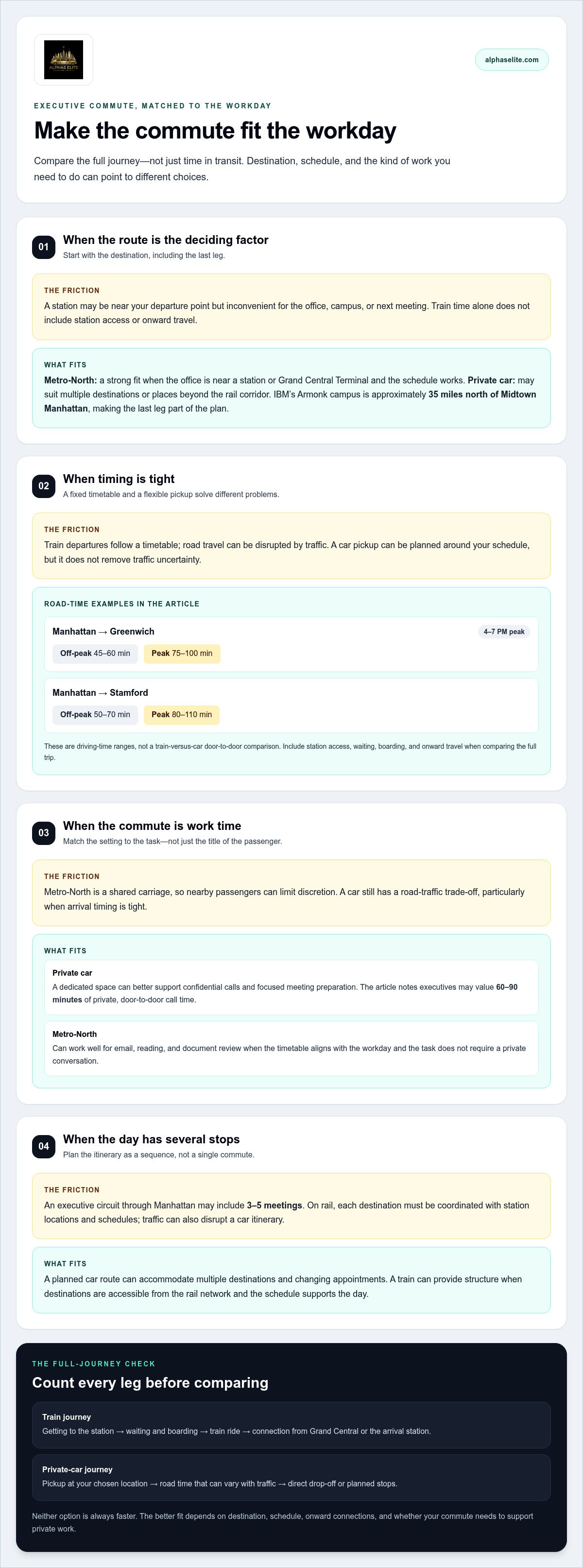
Private car versus Metro-North for executive commuting
Choosing private car service vs Metro-North for executive commuting depends on your workday, not your status. A car offers a private setting; Metro-North has shared spaces and fixed routes. A car may better suit confidential calls, quiet preparation, or changing appointments. Train time can work well for reading and tasks that do not require a private conversation.
Comfort and Privacy on Each Option
A private car gives each passenger a dedicated space, while Metro-North places commuters in a shared carriage. That distinction matters for sensitive calls or reviewing confidential material. Executives may value 60-90 minutes of private door-to-door call time in a car. On the train, nearby passengers and conversations can limit discretion. Road congestion remains a trade-off for car travel, especially when arrival timing is tight.
Productivity During the Commute
Match the mode to the task. Metro-North can suit email, reading, and document review when the train schedule aligns with the workday. A car can better support calls and focused meeting preparation. An executive circuit through Manhattan may include 3-5 meetings, making a planned route useful between appointments. The decision of private car service vs Metro-North for executive commuting should account for these work needs alongside the itinerary.
Work-from-home days can change the calculation. Instead of choosing one mode for every weekday, consider the purpose of each office trip. Rail may suit a day near Grand Central; a day with client visits across several locations may favor a direct pickup. Traffic can still delay road travel, so leave room in your schedule around time-sensitive meetings.
Before booking, identify confidential calls, fixed appointments, and stops beyond the office. Choose Metro-North when its schedule and station access suit your day. Choose a private car when privacy, direct pickup, or multiple destinations matter more. Reassess private car service vs Metro-North for executive commuting as your itinerary changes.
A 55-mile round-trip commute has estimated driving-alone costs of 42.35 daily and 889.35 monthly, using 21 working days monthly. Private-car cost from White Plains to Manhattan depends on vehicle, pickup and destination, travel time, passenger count, and luggage. Metro-North charges group members individually; private vehicles are usually arranged for groups. Peak traffic can affect travel times.
What are the tax benefits or employer commuter benefits for Metro-North versus private car service?
Employer commuter benefits can change the effective cost of a Metro-North trip, but eligibility depends on the company’s benefit plan. When an employer offers the benefit, employees may use up to $300 per month of pre-tax income for transportation costs, as of Jan. 1, 2023. Section 132(f) of the Internal Revenue Code addresses qualified transportation fringe benefits.
That provision does not mean every commuting expense receives the same treatment. A train fare and a privately booked car are different transportation arrangements, so don’t assume a car booking qualifies under your employer’s program. Review the written commuter-benefit terms first. Then identify which expenses are permitted and how employees access the benefit, such as through payroll deductions or an employer-provided account.
For a Metro-North commute, compare the benefit terms with the rail expenses you expect to submit. Include the regular journey and any connecting transportation, such as a trip to the station or onward travel from Grand Central Terminal. For private-car commuting, distinguish the commute from other executive travel. The benefit’s wording, the trip’s purpose, and the employer’s administration determine how the expense is handled.
A practical review can follow three steps:
- Read the employer’s commuter-benefit policy and identify its eligible transportation expenses.
- Separate Metro-North fares, station connections, and private-car bookings in your records.
- Ask the employer’s benefits administrator how the policy applies to your planned commute.
This comparison is especially useful when you commute on some days and work from home on others. Match the benefit process to each travel day rather than assuming a monthly arrangement suits every itinerary. If an executive trip also includes an airport connection, arrange private aviation transfers as part of the wider travel plan.
Alphas Elite: Medical Appointment Transport
Alphas Elite offers Medical Appointment Transport for trips where getting to an appointment is the priority. Corporate Transportation can serve executive journeys to the office, while Hourly Service suits itineraries with multiple stops or changing schedules. Airport Transfers cover journeys that begin or end at an airport.
Choose according to the day’s purpose: rail may suit a regular station-to-office routine, while a booked vehicle can serve appointment travel, business stops, or airport connections. These services can help when a train route doesn’t fit your full itinerary.
Contact Alphas Elite to arrange transportation that fits your schedule and destination.
Make Your Next Commute Work for You
Treat the private car service vs Metro-North for executive commuting decision as part of your weekly planning, not a permanent choice. Your priorities may change with the workday, whether it involves a focused commute, a client visit, or travel beyond the office. Choose the option that suits each trip, then adjust as your schedule changes.
When a trip calls for a coordinated vehicle rather than a rail journey, Alphas Elite offers Corporate Transportation, Medical Appointment Transport, and Airport Transfers across New York, Westchester, and Connecticut. Each service supports a different business or personal travel need, while your commute-planning criteria remain the same.
Consider the next journey on your calendar and identify the destination, schedule, and work you need to do along the way. For help arranging transportation around that itinerary, contact Alphas Elite about your commute. A considered plan can make each travel day feel more purposeful.
Frequently Asked Questions
Can a booked service handle daily executive commute?
Yes. Alphas Elite offers Corporate Transportation for executive travel in New York, Westchester, and Connecticut. For a recurring commute, define your usual pickup point, office destination, and regular schedule changes so each trip can be planned around your workday. A booked car is especially useful when the commute includes client visits or business stops beyond the office.


